Cake Cutting Guides: A Comprehensive Overview
Navigating cake serving sizes and portioning can be simplified with readily available online calculators and downloadable PDF guides, ensuring a delightful experience.
Understanding Cake Serving Sizes
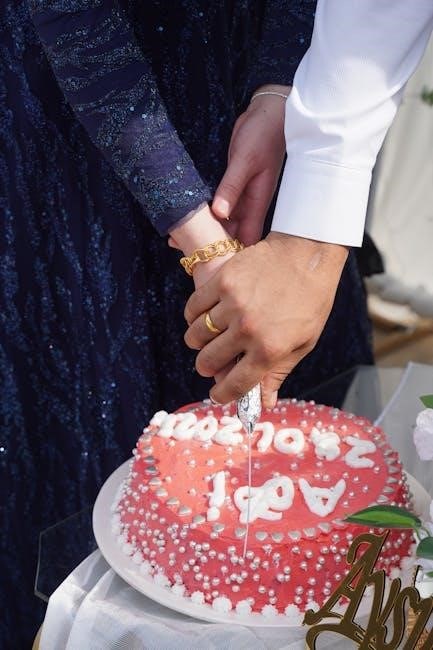
Determining appropriate cake serving sizes is crucial for event planning. Printable cake cutting guides often illustrate both “standard party slices” and smaller “wedding portion” sizes, impacting the total servings yielded from a cake. These guides visually demonstrate how to cut cakes for optimal distribution, preventing waste and ensuring everyone receives a piece.
Understanding these differences is key; wedding portions are traditionally smaller, allowing for more guests to enjoy the cake. Resources like online calculators and downloadable PDFs provide detailed charts, often brand-specific (like Wilton), to estimate servings based on pan size and desired slice style. Accurate serving size assessment prevents shortages or excessive leftovers, contributing to a successful celebration.
Determining Cake Size Based on Guest Count
Utilize printable charts to correlate guest numbers with appropriate cake tier sizes, guaranteeing sufficient servings for a memorable event experience.
Standard Party Slice vs. Wedding Portion
Understanding the difference between standard and wedding portions is crucial for accurate cake sizing. Printable guides often illustrate these distinctions, showcasing how a “standard party slice” is generally larger than a traditional “wedding portion.” Wedding slices are historically smaller, intended for guests enjoying a wider variety of desserts.
Consequently, a cake planned with wedding portions will yield more servings than one cut with standard slices. Printable charts frequently provide serving estimates for both cutting styles, allowing bakers and event planners to choose the appropriate method. These guides help avoid under or overestimating the cake’s capacity, ensuring every guest receives a delightful treat without excessive waste. Careful consideration of portion size, aided by printable resources, is key to successful cake planning.
Calculating Servings Per Tier
Printable cake cutting guides are invaluable when determining servings per tier for multi-tiered wedding cakes. These charts typically outline expected yields based on tier diameter or shape – round, square, or rectangular. They often differentiate between wedding and party portion sizes, impacting the total number of servings.
Guides provide a quick reference for estimating how many guests each tier will accommodate, simplifying the planning process. Some resources offer detailed tables correlating pan size with approximate servings. Utilizing these printable charts ensures accurate calculations, preventing shortages or excessive leftovers; Proper tier-by-tier assessment, facilitated by these guides, leads to a perfectly portioned and beautifully presented wedding cake.
Cake Pan Sizes and Serving Yields
Printable charts detail serving yields for various pan shapes—round, square, rectangular, and sheet cakes— aiding in accurate cake sizing and portion planning.
Round Cake Pans: Serving Charts
Detailed printable charts specifically for round cake pans are invaluable for event planning. These charts correlate pan diameter with estimated serving counts, crucial for avoiding shortages or excessive leftovers.
Typically, a 6-inch round cake yields approximately 12 servings when cut into standard party slices, while an 8-inch round can provide around 16-20 servings. Larger 10-inch and 12-inch rounds dramatically increase capacity, offering 28-32 and 40-48 servings respectively.
Remember that wedding portions are traditionally smaller, potentially doubling the serving yield from a single cake. Utilizing these printable guides ensures accurate batter estimation and appropriate pan selection, guaranteeing a perfectly portioned dessert for your guests.
Square & Rectangular Cake Pans: Serving Charts
Printable serving charts for square and rectangular pans are essential for efficient cake planning, offering a different approach to portioning compared to round cakes. These charts typically display serving estimates based on pan dimensions – length and width.
A 9×13 inch rectangular cake commonly yields 24-30 servings with standard cuts, making it ideal for larger gatherings. Square pans, like an 8×8 inch, provide around 16 servings, suitable for smaller events. Larger square options, such as 12×12 inches, can serve 36-48 guests.
Consider wedding portion sizes when using these charts; smaller cuts will significantly increase the total servings. Printable guides simplify batter calculations and pan choice, ensuring a beautifully presented and adequately portioned cake.
Sheet Cake Pans: Serving Charts
Printable charts for sheet cakes are incredibly useful due to their large surface area and efficient serving potential. These charts typically focus on the pan’s dimensions – length and width – to estimate servings.
A standard half-sheet cake (18×13 inches) generally provides 24-48 servings, depending on cut size. Full-sheet cakes (24×18 inches) can easily serve 48-96 guests, making them perfect for large events or parties. These charts often differentiate between party and wedding portion sizes.
Utilizing a printable guide ensures accurate batter quantities and prevents waste. Remember that rectangular cuts maximize servings from a sheet cake. These resources simplify planning and guarantee enough cake for everyone, streamlining the baking process.

Visual Cake Cutting Diagrams
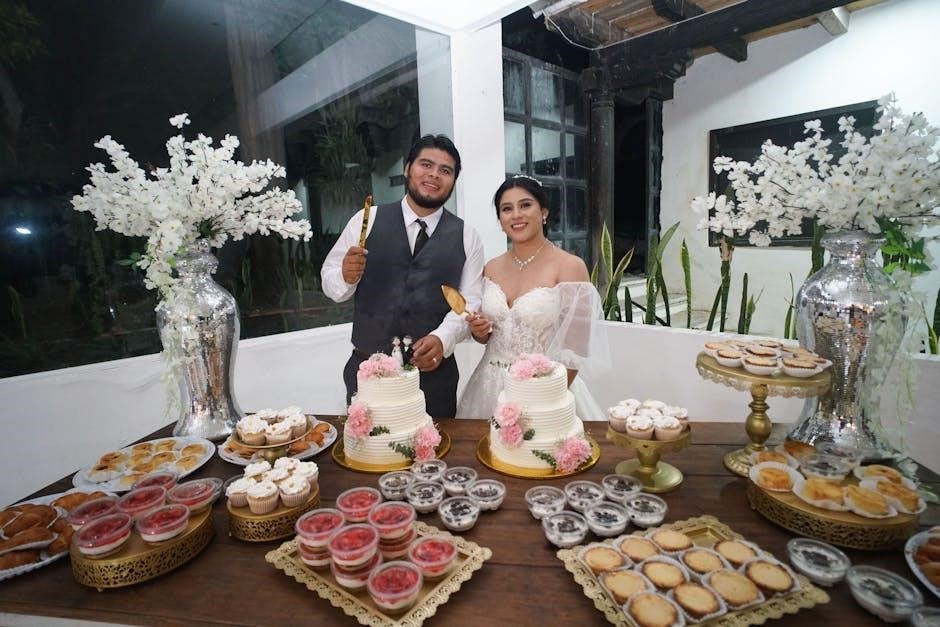
Diagrams illustrate optimal cutting patterns for various cake shapes and sizes, maximizing servings and providing a clear, printable guide for bakers.
Traditional Wedding Cake Cutting Guide
Historically, wedding cake cutting symbolized the couple’s first task together, and a precise guide ensures a smooth, symbolic moment. Printable diagrams often depict a tiered cake, illustrating how to start from the center and work outwards, creating wedge-shaped slices.
These guides frequently showcase a technique where the top tier is supported during cutting, preventing collapse. They emphasize cutting through all layers simultaneously for clean, even portions. Many downloadable PDFs include numbered steps and visual aids, detailing the proper hand positioning and knife angle.
Furthermore, these guides often suggest a specific order for cutting tiers, starting with the top and progressing downwards, ensuring each guest receives a piece from every layer. The tradition dates back to Ancient Rome, and these guides help maintain its elegance.
Modern Cake Cutting Techniques
Contemporary cake cutting often prioritizes presentation and ease, diverging from strictly traditional methods. Printable guides now showcase techniques like pre-cutting cakes in the kitchen for larger events, minimizing on-site fuss.
These modern diagrams illustrate using a long, serrated knife for clean cuts through multiple layers, and some suggest warming the knife for even smoother slicing. Many downloadable PDFs feature guides for cutting uniquely shaped cakes, like those with uneven tiers or sculpted designs.
Furthermore, they often include tips for portioning cakes with varying densities and fillings, ensuring each slice is enjoyable. These guides also address serving guests with dietary restrictions, offering suggestions for pre-cutting allergen-free portions.
Wilton Cake Serving Charts
Wilton charts are popular resources for bakers, providing batter estimation and serving size guidance, often available as free downloadable PDF files online.
Using Wilton Charts for Batter Estimation
Wilton cake serving charts aren’t just for determining how many people a cake will feed; they’re incredibly useful for estimating the amount of batter needed for each pan size. This is a crucial step in baking, preventing wasted ingredients or, conversely, not having enough batter to fill your pans properly.
These charts typically detail the batter volume required for various pan shapes – round, square, rectangular, and sheet cakes – correlated with the desired number of servings. Bakers often find that the batter estimations vary slightly depending on their specific recipe and baking techniques, but the Wilton charts provide a solid starting point.
Utilizing these charts helps ensure consistent results and minimizes guesswork, especially when scaling recipes up or down. Many printable versions are available online, making it easy to keep a handy reference guide in the kitchen.
Comparing Wilton and Other Brand Charts (Pelo Orkut)
When selecting a cake serving chart, it’s beneficial to compare different brands, such as Wilton and Pelo Orkut, to understand potential variations in serving size estimations. These differences often stem from varying definitions of a “standard” serving. Wilton charts are widely recognized and frequently used by professional and home bakers alike, offering detailed tables for diverse pan shapes.
Pelo Orkut charts, while potentially less common, provide an alternative perspective on serving yields. Comparing these charts reveals discrepancies in slice size assumptions, impacting the total number of servings calculated for a given cake. Understanding these nuances is vital for accurate cake planning.
Careful consideration of these brand-specific differences ensures you order or bake a cake that adequately caters to your guest count, avoiding shortages or excessive leftovers.
Historical Context of Wedding Cakes
Wedding cakes, originating in Ancient Rome, symbolize prosperity; sharing them with loved ones was believed to bring good fortune to the marriage.
The Tradition of Sharing Wedding Cake
Historically, the sharing of wedding cake wasn’t merely a sweet treat, but a symbolic act deeply rooted in ancient customs. Originating in Roman times, offering cake signified the couple’s shared future and a wish for fertility. Over time, this evolved into a gesture of goodwill and prosperity extended to guests.
The act of cutting and distributing the cake became a focal point of the reception. Early cakes were often fruitcakes, representing wealth and abundance. Guests partaking in the cake were believed to receive a blessing for a happy marriage and future success.
Today, while the symbolism may be less overt, the tradition persists. Modern couples often choose cake flavors and designs reflecting their personalities, yet the core idea of sharing joy and celebrating with loved ones remains central to the wedding cake experience.
Factors Affecting Serving Size
Accurate serving estimations require considering cake density, filling types, and guest appetites, alongside any dietary needs or restrictions present at the event.
Cake Density and Filling Types
The density of a cake significantly impacts serving sizes; a light and airy sponge cake will yield more portions than a dense pound cake. Similarly, the type of filling plays a crucial role. Cakes with substantial fillings, like buttercream or ganache, often necessitate smaller slices to maintain balance and prevent overwhelming sweetness.
Consider a delicate chiffon cake versus a rich chocolate fudge cake – the fudge cake, being heavier, will naturally serve fewer people per inch. Generous fillings also affect how easily a cake cuts cleanly, potentially leading to uneven portions if not accounted for during initial planning. Therefore, when utilizing printable cake cutting guides, always factor in these variables for a more accurate estimation of servings.
Guest Appetite and Dietary Restrictions
Accurate cake sizing requires considering your guests’ appetites and any dietary needs. A crowd with hearty eaters will consume larger portions than those with smaller appetites. Printable cake cutting guides often assume a standard serving size, which may need adjustment.
Furthermore, accommodate guests with dietary restrictions – gluten-free, vegan, or allergy-related – by providing separate, appropriately sized cakes. Failing to do so could leave some guests without a suitable dessert option. When planning, overestimate slightly to ensure everyone receives a satisfying piece. Remember, a little extra cake is always better than running out, especially when catering to diverse preferences and needs.
Resources for Printable Cake Cutting Guides
Numerous online serving size calculators and downloadable PDF guides simplify cake portioning, offering convenient tools for bakers and event planners alike.
Online Serving Size Calculators
Several websites offer interactive cake serving size calculators, streamlining the planning process for events of any scale. These tools typically request information like the number of guests and the desired portion size – standard party or traditional wedding – to estimate the appropriate cake dimensions.
These calculators often incorporate charts detailing serving yields from various pan shapes (round, square, rectangular, sheet) and tiers, eliminating guesswork. Users can input specific pan dimensions to receive a tailored serving estimate. Some even allow adjustments for cake density and filling types, providing a more accurate prediction.
Accessing these resources is generally free and requires no registration, making them incredibly convenient. They are particularly useful for those unfamiliar with traditional cake cutting guides or seeking a quick and reliable solution for determining cake size.
Downloadable PDF Guides
Numerous websites provide printable PDF cake cutting guides, offering a tangible resource for bakers and event planners. These guides often feature visual diagrams illustrating optimal cutting patterns for different cake shapes and sizes, maximizing serving yield.
Many PDFs include detailed serving charts, categorizing pan sizes and corresponding slice counts for both standard party portions and smaller, more formal wedding servings. Some guides also incorporate batter estimation charts, assisting in ingredient calculations based on desired servings.
These downloadable resources are ideal for offline access, eliminating reliance on internet connectivity during baking or event setup. They provide a comprehensive reference point, ensuring accurate cake sizing and efficient serving, contributing to a seamless and enjoyable experience.